
Featured Product
The Featured Product block is a dynamic showcase tool designed to highlight specific items from your inventory with precision and style. By allowing you to handpick selections from your latest arrivals or top-sellers, it transforms standard product listings into high-impact visual features. Whether you want to present a curated collection in a clean, structured Grid or an interactive, space-saving Carousel, this block provides the versatility needed to adapt to any page layout while significantly boosting user engagement.
Settings ⚙
General
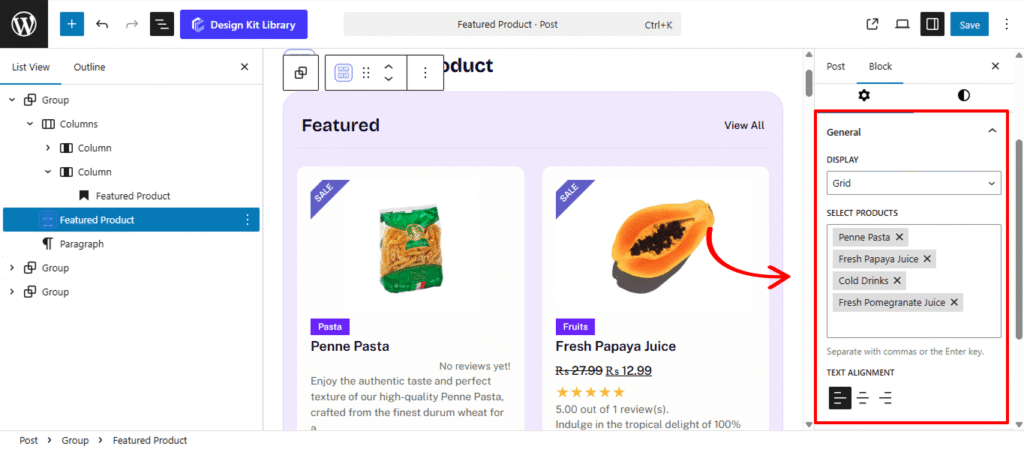
- Display: Select the primary organizational framework for your products.
- Grid: Arranges products in a stable, multi-column format. This is the standard choice for “Shop” pages or detailed product catalogs where structure is key.
- Carousel: Converts the product list into a horizontal, touch-ready slider. This is perfect for homepages where you want to showcase multiple items without taking up excessive vertical space.
Query Option
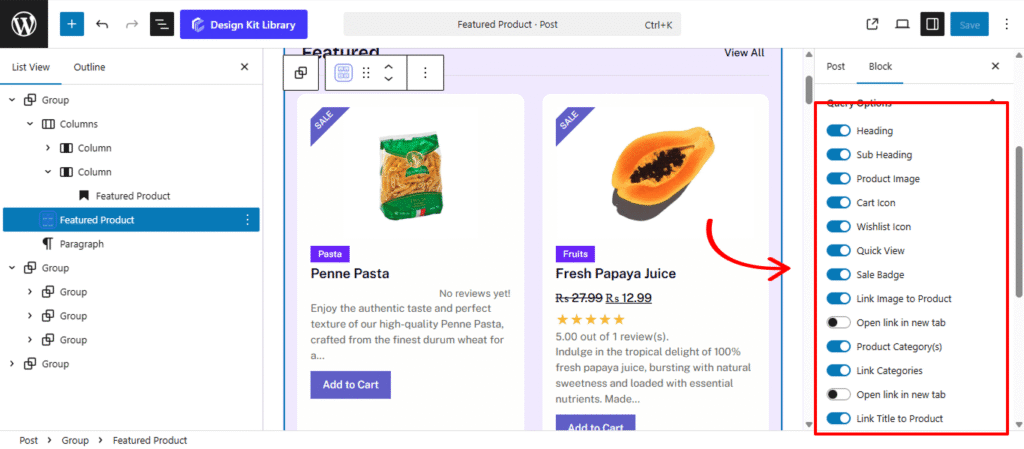
The Query Options Panel serves as the visibility engine for the Featured Product Block. It allows you to toggle and fine-tune every individual element within the product card, giving you total control over the information hierarchy. Whether you want a minimalist look with just an image and price, or a feature-rich card for a high-conversion landing page, these toggles allow you to curate the perfect display.
- Heading & Sub Heading: Enable these to add custom titles or taglines directly above the product information.
- Link Image to Product: Turns the entire image into a clickable hotspot.
- Icons:
- Toggle the Cart Icon, Wishlist Icon, and Quick View buttons. These provide instant interaction points without requiring a full page load.
- Sale Badge: Automatically displays a visual “Sale” or “Discount” indicator for products with a reduced price.
- Link Categories: When active, users can click the category name to browse related items.
- Link Title to Product: Provides a direct, SEO-friendly link to the single product page.
- Product Rating: Showcases the star rating based on verified customer reviews.
- Product Price: Displays the current price, including strike-through pricing for items on sale.
- Product Summary & Excerpt: Choose between the full short description or a truncated snippet (excerpt) to maintain a uniform card height.
- Product Summary & Excerpt: Choose between the full short description or a truncated snippet (excerpt) to maintain a uniform card height.
- Add to Cart Button: Enable the primary call-to-action, allowing customers to move from “browsing” to “buying” with a single click.
Note: Each linkable element includes a dedicated “Open Link in New Tab” toggle, providing granular control over how shoppers navigate your store.
Header Options
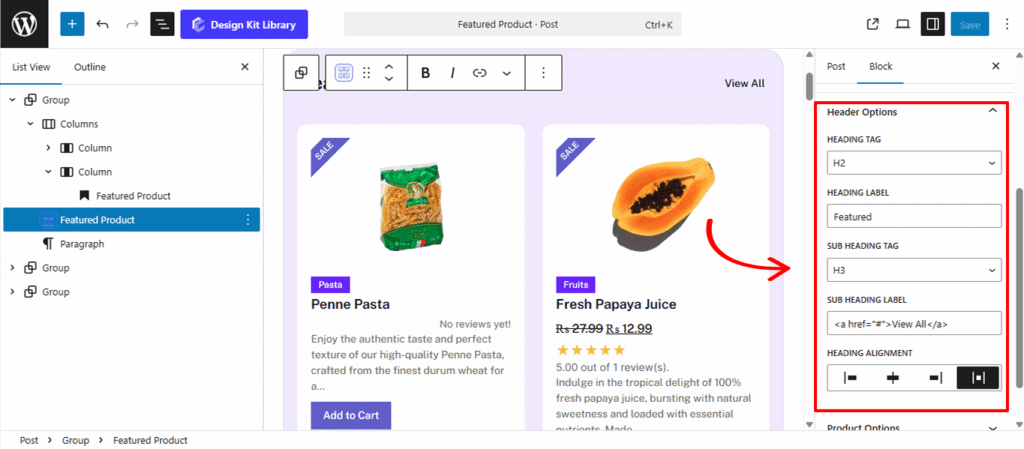
Based on the image of the editor interface, here are the documentation details for the Header Options panel within the Featured Product block:
- Heading Tag: Choose the appropriate HTML rank (from H1 to H6) for your main title. This ensures your “Featured” section is correctly indexed by search engines and maintains a proper document hierarchy.
- Heading Label: Enter the primary title for your block. Use this field to give your collection a name, such as “Best Sellers,” “New Arrivals,” or “Top Picks.”
- Sub Heading Tag: Select the HTML tag for your secondary text. This is typically used for taglines or supplementary links.
- Sub Heading Label: Enter the text or HTML for your sub-header. As shown in the example, this field supports anchor tags (e.g.,
<a href="#">View All</a>), allowing you to place a “View All” link directly beside your heading. - Heading Alignment: Control the horizontal placement of both the heading and sub-heading. You can choose between Left, Center, Right, or Justified layouts to match the rest of your page design.
Product Options
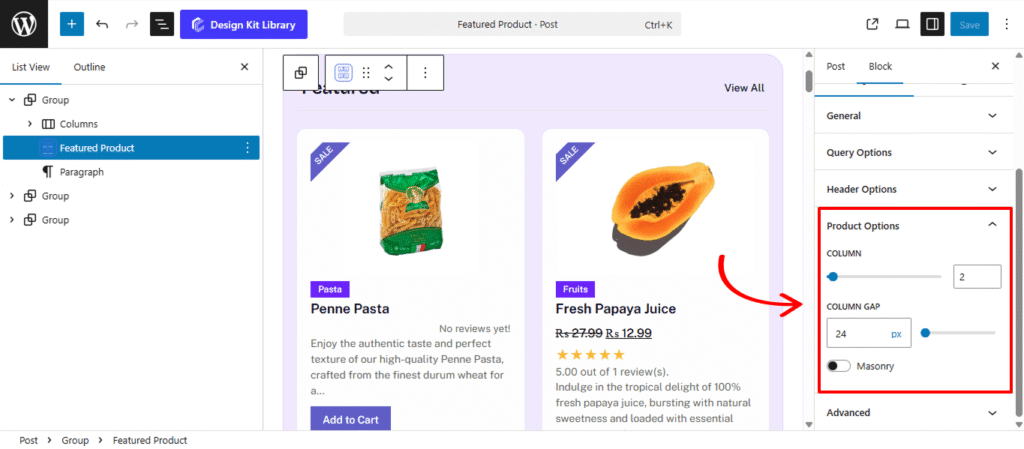
The Product Options panel controls the spatial arrangement and structural flow of your product cards. These settings allow you to transform a basic list into a professional, well-spaced gallery that adapts to your site’s layout requirements. This Panel is available only when the Display is set to Grid.
- Column: Define the number of products displayed in a single horizontal row. You can set different column counts for desktop, tablet, and mobile to ensure your featured items remain perfectly sized on every screen.
- Column Gap: Adjust the precise amount of white space between each product card. Increasing this gap creates a cleaner, more minimalist “breathable” look, while a smaller gap allows for more content density in high-inventory stores.
- Masonry: When enabled, this layout optimizes the vertical space between products of varying heights. Instead of forcing cards into rigid rows, Masonry shifts them upward to fill empty gaps, creating a dynamic, modern “Pinterest-style” grid that is perfect for products with varying image aspect ratios or description lengths.
Carousel Options
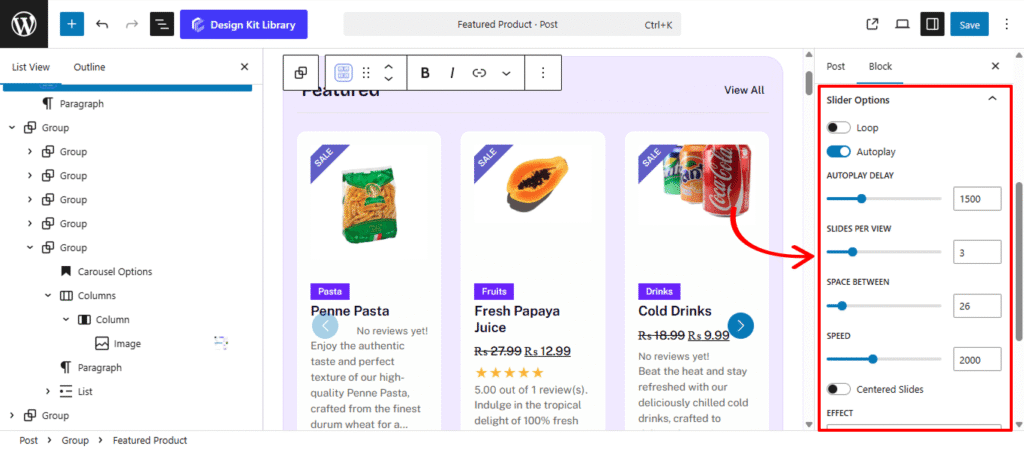
The Carousel Options panel provides the settings necessary to transform your featured product list into an interactive, sliding showcase. This display mode is ideal for presenting large collections without taking up excessive vertical space on your page. This Panel is available only when the Display is set to Carousel.
- Loop: Enable this to allow the carousel to wrap around indefinitely. Once the shopper reaches the last product, the slider seamlessly transitions back to the first.
- Autoplay: Activate this to have the products slide automatically. This is a great way to showcase a large inventory without requiring user interaction.
- Autoplay Delay: Set the duration (in milliseconds) that each product remains static before the next one slides into view.
- Slides Per View: Define how many products are visible in the slider at once.
- Space Between: Adjust the horizontal spacing between each product slide to prevent your layout from feeling cluttered.
- Speed: Control the transition velocity. A higher value creates a slow, cinematic glide, while a lower value makes for a snappy, high-energy transition.
- Centered Slides: Toggle this to keep the active product card positioned in the middle of the viewport. This is particularly effective for high-impact hero sliders where you want to draw the eye to a single featured item.
- Enable Pagination: Displays “dots” or “bullets” at the bottom of the carousel, providing a visual progress indicator for the shopper.
- Enable Navigation: Adds directional arrows to the left and right, allowing users to manually browse through your collections.
- Display on Hover: Use this to pause the Autoplay when a user moves their mouse over a specific product. This ensures they have plenty of time to view the details or click the “Add to Cart” button without the slide moving away.
Style ◑
Header Box Styles
The Header Box Styles panel provides the layout and aesthetic controls for the container housing your component’s title and introduction. By customizing these settings, you can create a distinct visual separation between the header content and the main body, ensuring a structured and professional appearance for any section of your site.
- Padding: Adjust the internal breathing room around your heading text. Increasing padding creates a more prominent, “framed” look for the header area.
- Margin Top & Bottom: Control the external vertical spacing. Use Margin Top to separate the header from the elements above it, and Margin Bottom to define the distance between the header and the main content below.
- Border: Define a stroke style, width, and color to outline the header container. This is a great way to add structural definition or a subtle decorative touch.
- Border Radius: Control the roundness of the box corners. Use 0px for a sharp, formal rectangle or higher values to create soft, modern curves that match your site’s design language.
- Color:
- Background Color: Set the fill color for the header container. Applying a subtle background color can help the title stand out as a clear visual anchor for the section.
Heading Styles
The Heading Styles panel provides dedicated controls to customize the visual character of your component’s main title. These settings allow you to go beyond standard typography, turning your heading into a stylized design element that captures the user’s attention.
- Padding: Adjust the internal space between the text and the boundary of the heading’s background or border. This is essential for ensuring the text doesn’t feel cramped when using background colors.
- Border: Apply a stroke style, width, and color around the heading. This can be used to underline, frame, or fully encase the title for added emphasis.
- Border Radius: Define the curvature of the heading’s corners. This works in tandem with the background or border to create a sleek, modern look.
- Clip-path: Enter a custom CSS clip-path value (such as
polygon(50% 0, 100% 50%, 50% 100%, 0 50%)orcircle(40%)) to create unique, non-rectangular shapes for the heading’s background. This allows for creative, high-end design layouts like slanted or notched headers. - Color:
- Text Color: Set the primary color for the heading typography to ensure it is legible and brand-consistent.
- Background Color: Apply a fill color specifically to the heading area, which can be used to create a “badge” or “highlight” effect behind the title.
Sub Heading Styles
The Sub Heading Styles Panel allows you to refine the secondary text or links within your header. This is particularly useful for styling “View All” links or descriptive taglines, providing a clear visual hierarchy and interactive feedback for users.
- Padding: Adjust the internal space around the sub-heading text. This is essential if you are styling the sub-heading as a button or badge to ensure the text has balanced breathing room.
- Border: Define the stroke style and width. A subtle border can help transform a simple text link into a sophisticated call-to-action.
- Border Radius: Control the roundness of the corners. Use a high value to create a pill-shaped button or 0px for a classic rectangular look.Vertical & Horizontal Positioning: Use these granular offsets to “pin” the badge to specific areas of the product image. You can tuck it into the top-right corner or center it along the bottom edge for a unique look.
- Typography
- Font Family & Size: Select the typeface and scale that best matches your site’s design system.
- Font Weight: Control the thickness (e.g., Bold for emphasis or Light for a modern look).
- Letter Case: Force the labels to Uppercase, Lowercase, or Capitalize without editing the form code.
- Decoration: Apply styles like Underline or Line-through if needed for specific design cues.
- Line Height & Letter Spacing: Fine-tune the vertical breathing room and horizontal character density.
- Color
- Text (Default/Hover): Set the base color for your text and define a hover color to provide immediate visual feedback when a user interacts with the link.
- Background (Default/Hover): Apply a background fill to the sub-heading area. Switching the background color on hover creates a dynamic, “button-like” feel.
- Border Hover: Change the outline color during a hover event to further emphasize the interactivity of the element.
Product Box Styles
The Product Box Styles panel governs the container of the individual product card. These settings allow you to define the outer structure and interactive behavior of each item, ensuring your products are presented with consistent spacing and engaging motion.
- Padding: Adjust the internal space between the product content (image, title, price) and the edge of the box. This creates a balanced, professional frame for each item.
- Margin Top & Bottom: Control the external vertical spacing. This defines the gap between the product cards and the elements above or below the block.
- Border: Apply a stroke style and color to the product container. A subtle border can help separate products from the page background, especially on minimalist white layouts.
- Border Radius: Define the curvature of the box corners. Use a higher value for a soft, friendly look or 0px for a sharp, modern aesthetic.
- Hover Effect: When toggled on, this adds a “lift” animation to the product card. When a user mouses over the box, it translates slightly upwards, creating a sense of depth and providing clear visual feedback that the product is interactive.
- Default / Hover States: Use the toggle tabs to define different styles for the “Normal” and “Hover” states. You can shift colors, borders, or shadows to create a dynamic visual lift.
- Box Shadow: When the Box Shadow toggle is enabled, you can add depth and dimension to your container to make it “pop” off the page:
- Position: Choose Outline for a traditional drop shadow or Inset to make the shadow appear inside the container, creating a “pressed” effect.
- Horizontal & Vertical: Shift the shadow’s position along the X and Y axes to simulate a specific light source.
- Blur & Spread: Blur softens the edges of the shadow for a natural look, while Spread expands or contracts the overall surface area of the shadow.
- Shadow Color: Select the color and transparency (opacity) of the shadow effect.
- Box Shadow: When the Box Shadow toggle is enabled, you can add depth and dimension to your container to make it “pop” off the page:
- Typography
- Font Family & Size: Select the typeface and scale that best matches your site’s design system.
- Font Weight: Control the thickness (e.g., Bold for emphasis or Light for a modern look).
- Letter Case: Force the labels to Uppercase, Lowercase, or Capitalize without editing the form code.
- Decoration: Apply styles like Underline or Line-through if needed for specific design cues.
- Line Height & Letter Spacing: Fine-tune the vertical breathing room and horizontal character density.
- Color
- Background (Default/Hover): Apply a background fill to the sub-heading area. Switching the background color on hover creates a dynamic, “button-like” feel.
- Border Hover: Change the outline color during a hover event to further emphasize the interactivity of the element.
Product Styles
The Product Styles panel provides precise control over the presentation of the product imagery and typography. These settings allow you to standardize how your catalog appears, ensuring a uniform and professional look regardless of varying image sizes or title lengths.
- Product Image:
- Width & Height: Define the specific dimensions for the product images. Setting a fixed height is a great way to maintain a consistent “row” look across your entire layout.
- Radius: Control the corner roundness of the product image itself. This can be used to create soft, circular, or pill-shaped thumbnails.
- Object Fit (Cover/Contain): Use this toggle to decide how the image fills its container. Cover ensures the image fills the entire area (cropping if necessary), while Contain shows the full image without cropping, which is ideal for products where every detail matters.
- Object Position: Adjust the focal point of the image within the frame. If an image is cropped, you can choose to pin the focus to the Top, Center, Bottom, Left, or Right to ensure the most important part of the product is always visible.
- Margin Top & Bottom: Control the external vertical spacing around the image. This helps define the distance between the photo and the surrounding elements like the “Sale” badge or product title.
- Image Hover Effect: When active, the image will subtly zoom in when a user hovers over the card. This adds a layer of dynamic polish and draws the shopper’s eye toward the product details.
- Product Title / Content Typography:
- Margin Top & Bottom: Control the vertical breathing room for your product titles and descriptions. This allows you to create a clear hierarchy and prevent the text content from feeling crowded.
- Typography
- Font Family & Size: Select the typeface and scale that best matches your site’s design system.
- Font Weight: Control the thickness (e.g., Bold for emphasis or Light for a modern look).
- Letter Case: Force the labels to Uppercase, Lowercase, or Capitalize without editing the form code.
- Decoration: Apply styles like Underline or Line-through if needed for specific design cues.
- Line Height & Letter Spacing: Fine-tune the vertical breathing room and horizontal character density.
Sale Badge Styles
The Sale Badge Style panel allows you to customize the visual indicators that highlight discounted products. These badges are essential for grabbing the shopper’s attention and communicating value at a glance.
- Padding: Control the internal space within the badge. Adjust this to give your percentage or text more breathing room.
- Border & Border Radius: Define an outline style and corner curvature. Use a high Border Radius for a circular or pill-shaped badge, or 0px for a classic rectangular sticker.
- Content Type: Choose what information is displayed.
- Default: Displays a standard “Sale” text.
- Percentage: Automatically calculates and shows the discount percentage (e.g., -20%).
- Amount: Displays the specific currency amount saved (e.g., Save $10).
- Label Before/After: Add custom prefix or suffix text to your discount values, such as “Up to” or “Off.”
- Position (Left/Right): Quickly anchor the badge to the left or right side of the product image.
- Vertical & Horizontal Positioning: Fine-tune the exact placement using coordinate offsets to ensure the badge doesn’t overlap critical parts of the product photo.
- Rotation: Tilt the badge to a specific angle (e.g., -45°) to create a dynamic “slanted sticker” effect.
- Typography
- Font Family & Size: Select the typeface and scale that best matches your site’s design system.
- Font Weight: Control the thickness (e.g., Bold for emphasis or Light for a modern look).
- Letter Case: Force the labels to Uppercase, Lowercase, or Capitalize without editing the form code.
- Decoration: Apply styles like Underline or Line-through if needed for specific design cues.
- Line Height & Letter Spacing: Fine-tune the vertical breathing room and horizontal character density.
- Colors
- Text & Background Color: Set the primary colors for the badge. Using high-contrast colors (like white text on a bright red or orange background) ensures the discount is the first thing a customer sees.
Util Icon Styles
The Util Icon panel provides comprehensive layout and styling controls for functional icons (such as Wishlist, Quick View, or Compare). These settings allow you to define the spatial positioning, sizing, and interactive behavior of these icons to ensure they are both accessible and visually integrated.
- Direction: Choose between a Horizontal or Vertical stack if you are displaying multiple utility icons.
- Vertical & Horizontal Align: Quickly snap the icon container to the Top, Bottom, Left, Center, or Right of its parent element.
- Vertical & Horizontal Positioning: Fine-tune the exact placement using coordinate offsets for precise “pixel-perfect” anchoring.
- Size: Control the scale of the icon itself.
- Box Width & Height: Define the dimensions of the clickable area surrounding the icon. This is essential for creating consistent touch targets for mobile users.
- Border & Border Radius: Apply an outline and define corner roundness. High radius values can transform the container into a perfect circle.
- Colors: Customize the appearance across three distinct interaction states (Default, Hover, and Active)
- Icon: Set the color of the glyph/graphic for each state.
- Background: Define the fill color of the icon’s container box. Changing this on hover or active states provides excellent tactile feedback.
- Border: Specifically adjust the border color, with a dedicated option for the Active state to highlight which utility is currently engaged.
Product Category Styles
The Product Category Styles panel allows you to customize the labels that identify which collection a product belongs to. These settings help you style category links as subtle text or prominent buttons, improving both site navigation and visual organization.
- Gap: If a product belongs to multiple categories, this setting controls the space between each individual category tag.
- Padding: Adjust the internal breathing room around the category text. Adding padding is useful for creating a “badge” or “pill” effect.
- Margin Top & Bottom: Control the external vertical spacing to define the distance between the category labels and surrounding elements like the product image or title.
- Border: Apply a stroke style and width to the category container.
- Border Radius: Define the roundness of the corners. Use high values to create modern, rounded tags that match your brand’s aesthetic.
- Hover Effect: Apply subtle animations or transitions to the category tag when a user mouses over it, ensuring the navigation feels responsive and polished.
- Hover Effect: Apply subtle animations or transitions to the category tag when a user mouses over it, ensuring the navigation feels responsive and polished.
- Typography
- Font Family & Size: Select the typeface and scale that best matches your site’s design system.
- Font Weight: Control the thickness (e.g., Bold for emphasis or Light for a modern look).
- Letter Case: Force the labels to Uppercase, Lowercase, or Capitalize without editing the form code.
- Decoration: Apply styles like Underline or Line-through if needed for specific design cues.
- Line Height & Letter Spacing: Fine-tune the vertical breathing room and horizontal character density.
- Colors: Customize the appearance across three distinct interaction states (Default, Hover, and Active)
- Text (Default/Hover): Set the base color for your category labels and define a hover color to provide clear visual feedback when a user interacts with the link.
- Background (Default/Hover): Apply a fill color behind the category text. Switching the background color on hover creates a dynamic, interactive feel.
- Border Hover: Specifically change the outline color during a hover event to further emphasize the link.
Demo
Featured
View All
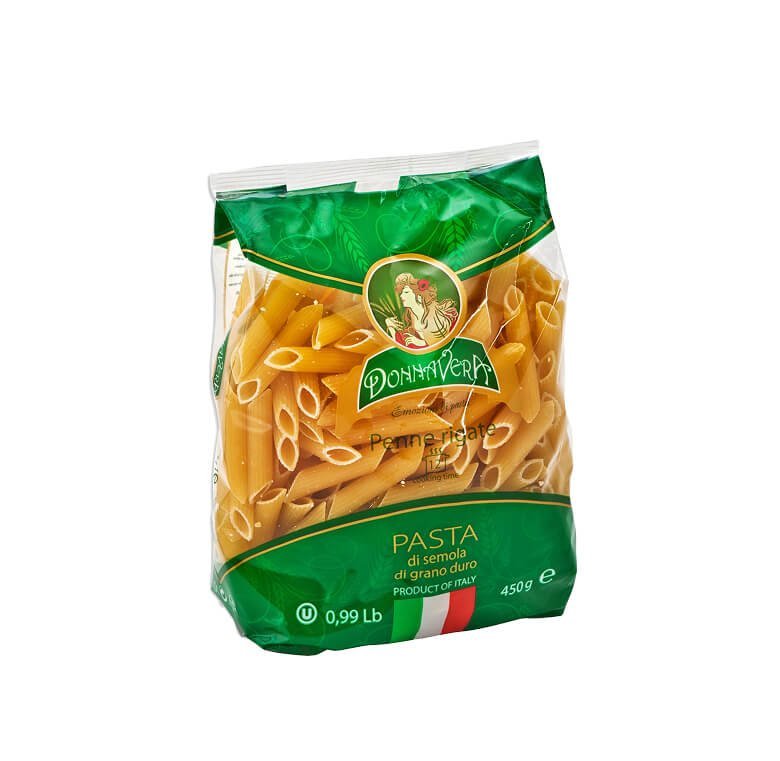 Sale
SalePenne Pasta
Original price was: .Current price is: .
Enjoy the authentic taste and perfect texture of our high-quality Penne Pasta, crafted from the finest durum wheat for a…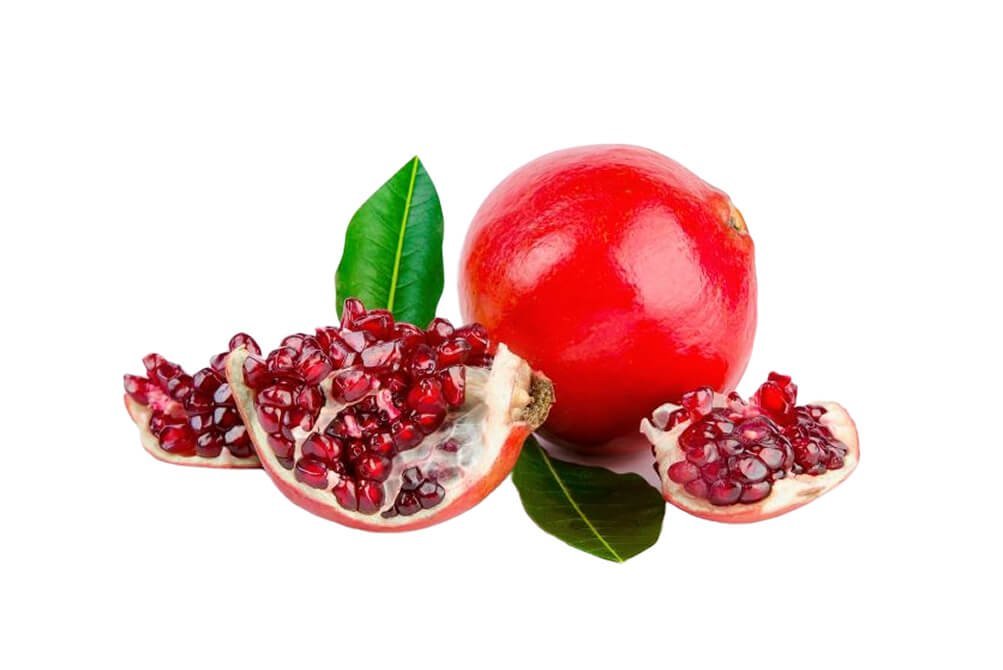 Sale
SaleFresh Pomegranate Juice
Original price was: ₨ 19.99.₨ 11.99Current price is: ₨ 11.99.
(5.0 out of 1 review.)Experience the refreshing taste and health benefits of 100% pure pomegranate juice, freshly extracted from premium-quality pomegranates to deliver a…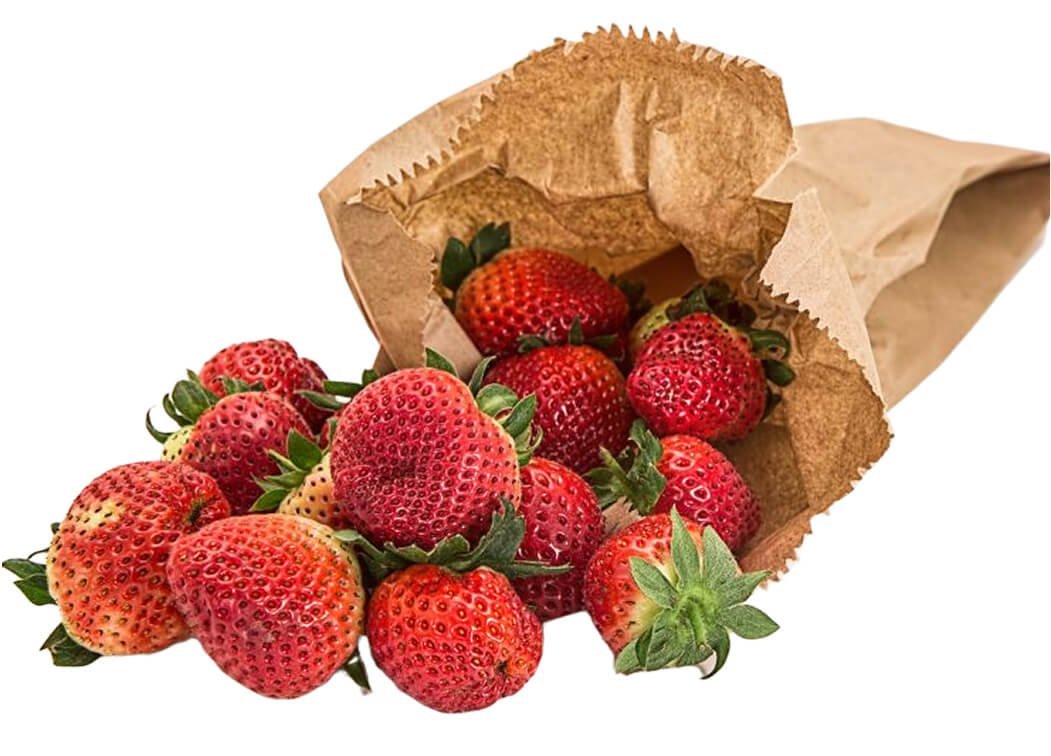 Sale
SaleFresh Strawberry
Original price was: ₨ 29.99.₨ 24.99Current price is: ₨ 24.99.
(4.0 out of 1 review.)Enjoy the natural sweetness and vibrant flavor of our fresh, handpicked strawberries, bursting with juicy goodness and rich in vitamins,…